Which of the Following Processes Generates the Most Atp
Besides which of the three stages of cellular respiration produces the most ATP. Which Metabolic Pathway Produces The Most Atp Which Metabolic Pathway Produces the Most ATP.
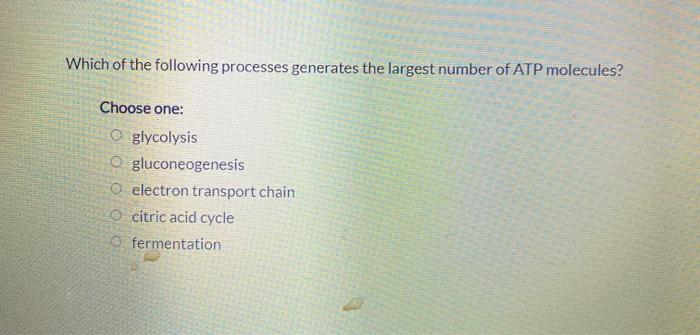
Solved Which Of The Following Processes Generates The Chegg Com
Citric acid cycle B.
. Long chain acyl-CoA. Acetyl-CoA generated by the beta-oxidation pathway enters the mitochondrial TCA cycle where it is further oxidized to generate NADH and FADH 2. The electron transport chain generates the most ATP out of all three major phases of cellular respiration.
So oxidative phosphorylation is the metabolic cycle that produces the most net ATP per glucose molecule. Glycolysis produces a net of 2 ATP per molecule of glucose. Slowest of all processes but makes 32 ATP.
Oxidative Phosphorylation Electron Transport ChainChemiosmosis. Electron transport begins with several molecules of NADH and FADH 2 from the Krebs cycle and transfers their energy into as many as 34 more ATP molecules. Account for the no.
Electron transport chain Explanation. Chloroplasts and mitochondria both create. Here energy to drive phosphorylation comes from oxidation-reduction reactions.
Which of the following processes generates the largest number of ATP molecules. Citric Acid Cycle. What is the overall chemical changes that occur during one complete turn of the Krebs cycle.
A aerobic respiration b glycolysis c alcoholic fermentation d lactic acid fermentation. Which of the following processes generates the most ATP. Cellular respiration with 36 atp.
Which of the following processes generates the most ATP. Account for the no. Where Does the Krebs Cycle Take Place in the Mitochondria.
Citric Acid Cycle b Fatty Acid oxidation c Glycogenolysis d Glycolysis e Pentose phosphate pathway 2. So you want to produce ATP you may know the steps of Arabic respiration which is the way we get the most ATP which is psychosis and then that we get the idea cycle and then. E Pentose phosphate pathway 2.
In TCA cycle or citric acid cycle total 2 molecules of of GTPATP are produced from two molecules of acetylchol View the full answer. Is it the credit card oxalic acid cycle pintos prostates pathway lactic acid fermentation or glycol Asus. Fatty Acid Oxidation produce the most ATP.
Which of the following processes generates the most ATP. B Fatty Acid oxidation Ans. Electron transport chain E.
What is the overall chemical changes that occur during one complete turn of the Krebs cycle. -Acetyl-CoA generated by the beta-oxidation pathway enters the mitochondrial TCA cycle where is further oxidized to generate NADH and FADH 2. ATP can be generated by many metabolic pathways in the body.
Glycogenolysis which is first initiated by the breakdown of glycogen to free glucose - 1 - phosphate G - 1 - P eventually generates a net total of 3133 ATP molecules from G - 1 - P depending on. Which of the following process produces the most ATP. When succinyl-CoA is converted to succinate in the appearance of the enzyme Succinyl CoA synthetase the Krebs cycle only generates two molecules of ATP from every pyruvate molecule.
The electron transport chain generates the most ATP out of all three major phases of cellular respiration. Which of the following processes generates the most ATP. Which of the following processes generates the most ATP.
Complete oxidation of one palmitate molecule fatty. The NADH and FADH 2 produced by both beta oxidation and the TCA cycle are used by the mitochondrial electron transport chain to produce ATP. What is chloroplasts and mitochondria relationship with ATP.
In anaerobic conditions pyruvate converts to lactate through. Which of the following processes produces the most ATP. Account for the no.
The electron transport chain makes the most ATP. Glycolysis produces two ATP molecules and the Krebs cycle produces two more. The NADH and FADH 2 produced by both beta oxidation and the TCA cycle are used by the mitochondrial electron transport chain to produce ATP.
In glycolysis total 4 molecules of ATP are produced from one molecule of glucose. Of ATP a Citric Acid Cycle b Fatty Acid oxidation c Glycogenolysis d Glycolysis e. Fatty acid β-oxidation c.
Of ATP a Citric Acid Cycle Ans. Which of these pathways gives the cell but potential to produce the most ATP. Account for the no.
Pentose phosphate pathway d. Production of 32 ATP molecules. Which of the following processes generates the most ATP.
It is a part of cellular respiration. Here is the breakdown of net ATP production. This process occurs in the cytoplasm of the cell.
What processes produces the most ATP. Oxidative phosphorylation produces the most ATP. B Fatty Acid oxidation.

Generation Of Metabolic Energy Organic Molecules Cells Activity Metabolism
What Process Produces Most Atp In Eukaryote Cells Quora

Nucleus In A Eukaryotic Cell A Membrane Bound Organelle That Contains The Cells Dna And That Has A Role In Processes Such As Grow Eukaryotic Cell Membrane Dna

Crayon Box Photosynthesis 광합성
No comments for "Which of the Following Processes Generates the Most Atp"
Post a Comment